Fix
Why does my cross stitch have gaps or look messy? Causes and fixes
Published
As an Amazon Associate we earn from qualifying purchases. This does not change our picks. Affiliate disclosure
New to Prime? Try Prime free for fast, free shipping on eligible items.
Short answer
Cross stitch has gaps when the thread does not cover its square of fabric. The most common cause is too few strands for the count: 14 and 16 count aida take 2 strands, 11 count takes 3. After that come twisted floss, top legs slanting in mixed directions, uneven tension and holes stretched by a needle that is too large. Light floss on dark fabric needs one strand more.
Gear for this job
All 7 picks comparedDMC 1767-24 Tapestry Hand Needles, Size 24
See price on AmazonSee it on AmazonDMC 1767-26 Tapestry Needles, Size 26
See price on AmazonSee it on AmazonKALIONE tapestry needles sizes 22, 24, 26, 30 pcs
See price on AmazonSee it on Amazon
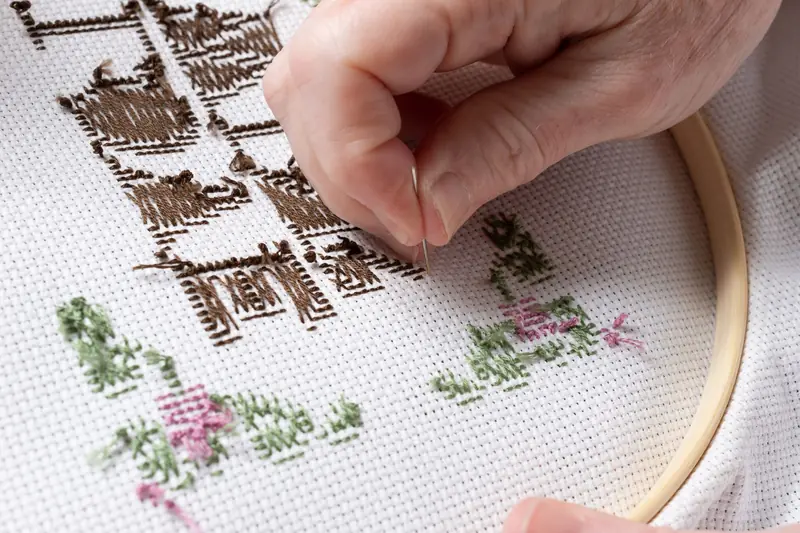
Gaps and a messy surface are two forms of one problem: the crosses are not all the same shape and fullness. Fabric count, strand number and needle size set how much thread fills each square. The way the thread is laid decides whether it spreads out flat or bunches into a cord. If the fabric itself is wrinkling around the stitches, that is puckering, which has its own page.
Gaps or messy cross stitch: what you see and the cause
Look at the piece in daylight from arm's length, then close up. Whether the fault is the same everywhere or changes from stitch to stitch tells you most of what you need.
| What you see | Likely cause | What to do |
|---|---|---|
| Fabric shows through every cross, evenly, across the whole piece | Too few strands for the fabric count | Add a strand: 2 on 14 and 16 count aida, 3 on 11 count. |
| Some crosses look thin and ropey. The thread sits like a cord | Twisted floss, or strands not separated first | Let the needle hang to untwist. Separate strands one at a time. Railroad the top leg. |
| Surface looks patchy. Light catches some crosses differently | Top legs slanting in mixed directions | Pick one direction for every top leg. Redo the odd crosses. |
| Some crosses fat, some pinched. Rows look wavy | Uneven tension | Pull each leg until it lies flat on the fabric, then stop. |
| Holes at the corners of the crosses look enlarged | Needle too large for the count | Tapestry size 24 for 14 count, 26 for 16 count, 28 for 18 count. |
| Dark fabric peeks out between light stitches | Light floss on dark fabric | Use one strand more than the usual number for that count. |
| Dark lines or shadows under light stitches or bare fabric | Thread carried across the back, or long tails | End the thread instead of carrying it. Trim tails close. |
Too few strands for the fabric count
Each count leaves a square of a fixed size to fill: 1.81 mm on 14 count aida, 1.41 mm on 18 count. The strand number has to match it. The usual figures are 3 strands on 11 count, 2 on 14 and 16 count, and 1 or 2 on 18 count. Evenweave and linen stitched over 2 follow the aida count of half their number, so 28 count over 2 takes 2 strands like 14 count.
Sources differ by one strand, and some patterns call for 1 strand on 18 count for a lighter look. If full coverage matters, stitch a small square in the margin of the fabric with each strand number and hold it up to the light. Fabric grid visible between the threads means add a strand. Stitches that look lumpy or crowd each other mean use one fewer. The strands chart lists every count, and the cross stitch calculator gives strands and needle for the count you enter.
Twisted floss and the cross stitch railroad technique
Two strands cover the most fabric when they lie side by side like a ribbon. Twisted together they form a narrow round cord that leaves the corners of the square bare. Twist builds as you stitch, because each pull through the fabric turns the needle a little. Every few stitches, let the needle hang from the work so the thread spins back. Floss used straight from the skein keeps its strands wound around each other, so pull out one strand at a time and lay them back together: see how to separate embroidery floss.
Railroading is the stricter fix. As the needle goes down to finish a leg, pass its tip between the two strands, close to the fabric, so one strand lies on each side of the needle like a pair of rails. The strands are forced flat and parallel on that leg. Many stitchers railroad only the top leg, since that is the one that shows.
The correct way to cross stitch: every top leg the same way
A cross is two diagonal legs. The bottom leg goes one way, the top leg the other, and every top leg in the piece must slant the same way. Thread reflects light along its length, so a cross with its top leg reversed looks like a slightly different shade and reads as a flaw. Which direction you choose does not matter. Staying with it does.
Working in rows makes this automatic. Stitch a row of half crosses, for example bottom left to top right in every square, then come back along the row completing each cross from bottom right to top left. The trap is turning the fabric a quarter turn to reach an awkward area: the legs then run the other way. Mark the top edge of the fabric with a safety pin in the margin and always stitch with it at the top. Crosses already stitched the wrong way have to be unpicked: see how to fix cross stitch mistakes.
Uneven tension and holes stretched by the needle
Tension in cross stitch means how far each leg is pulled. Too loose and the leg stands up from the fabric in a small arc. Too tight and it sinks in, pulls the fabric threads together and opens the hole next to it, which shows as a gap at the corner of the cross. The target is a leg that lies flat on the fabric and no more. Fabric held taut in a hoop or frame makes even tension easier than fabric held loose in the hand.
The needle should slip through the hole without moving the fabric threads. A tapestry needle that is too thick pushes them apart and leaves a hole the floss cannot fill. The usual sizes are 22 for 11 count, 24 for 14 count, 26 for 16 count and 28 for 18 count (26 is also used on 18). A bigger number is a finer needle: a John James size 24 is 0.76 mm across and a size 28 is 0.53 mm. Use a blunt tapestry needle. A sharp one pierces the fabric threads and the floss of the stitch next door.
Light floss on dark fabric and thread showing from the back
White or pale floss on black or navy aida shows every bare corner, because the contrast is as high as it gets. The usual answer is one strand more than the count normally takes: 3 strands on 14 count in place of 2. The opposite fault comes from the back: a dark thread carried behind pale stitches or unstitched fabric shows through as a shadow. End each thread under stitches of its own color and do not jump across open fabric.
What should the back of cross stitch look like?
Worked in rows, the back shows short straight lines with no diagonals. Thread ends are woven under 3 to 5 stitches and trimmed close, there are no knots, and no thread crosses a long stretch of bare fabric. It does not have to look like the front, and a design with many scattered colors will never have a tidy back. The back matters for two reasons only: lumps from knots show on the front once the piece is mounted, and dark carries show through. For starting and ending without knots, see the loop start page.
Can gaps be fixed without unpicking?
Thin coverage from too few strands can be: stitch over the same crosses again with one more strand, laying each leg in the same order as before. Reversed top legs and badly pinched crosses do not improve with more thread and have to come out. Stretched holes often close when the fabric threads are nudged back with the needle tip. Washing and pressing the finished piece settles the surface a little, but it will not hide bare fabric.
Quick answers
Short answers on gaps, neat stitching and the back of the work. The sections above give the reasons and the numbers for each fabric count.
- Why does my cross stitch look messy? Usually top legs slanting in mixed directions, twisted floss or uneven tension. Bare fabric comes from too few strands.
- How to cross stitch neatly? Use the right strands and needle for the count, keep every top leg the same way and pull each leg only until it lies flat.
- What is the correct way to cross stitch? Work in rows: half crosses out, completed on the way back, with all top legs slanting the same direction.
- What is the cross stitch railroad technique? Passing the needle between the two strands as it goes down, so they lie flat side by side.
- What should the back of cross stitch look like? Short straight lines, no knots, ends woven under 3 to 5 stitches and no long carries.
What you need for this
- See price on AmazonAmazon
DMC 1767-24 Tapestry Hand Needles, Size 24
From Best cross stitch needles: tapestry needles in sizes 24, 26 and 28
- See price on AmazonAmazon
DMC six-strand floss, 36 popular colors, 8.7 yd
From Best embroidery floss for hand embroidery: brand sets compared
- See price on AmazonAmazon
DMC GD1436-0322 Gold Label Aida Fabric, 14 Count
From Best 14 count aida cross stitch fabric: brands, cuts and colors
- See price on AmazonAmazon
Q-Snap Needlework Frame Bundle, 3 Sizes
From Best cross stitch frames: Q-Snap frames and scroll frames compared