Chart
Cross stitch needle sizes: which tapestry needle for each fabric count
Published Updated
As an Amazon Associate we earn from qualifying purchases. This does not change our picks. Affiliate disclosure
New to Prime? Try Prime free for fast, free shipping on eligible items.
Short answer
Use a size 24 tapestry needle on 14 count aida, size 26 on 16 count and size 28 on 18 count (size 26 is also used). Coarser fabric takes a thicker needle: size 22 for 11 count, 20 for 8 count and 18 for 6 count. Evenweave or linen stitched over 2 threads takes the needle for half its count, so 28 count uses a size 24.
Gear for this job
All 7 picks comparedDMC 1767-24 Tapestry Hand Needles, Size 24
See price on AmazonSee it on AmazonDMC 1767-26 Tapestry Needles, Size 26
See price on AmazonSee it on AmazonKALIONE tapestry needles sizes 22, 24, 26, 30 pcs
See price on AmazonSee it on Amazon
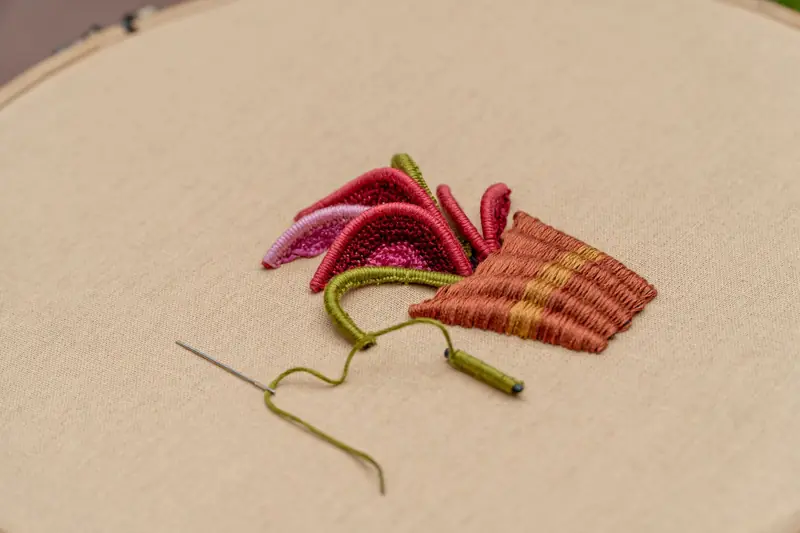
A cross stitch needle is a tapestry needle: blunt tip, large eye, sizes 13 to 28. The fabric count decides the size, because the needle has to slip through the hole without forcing it wider. The sizes on this page are for hand stitching on aida, evenweave and linen. They are the usual recommendations printed by stitching magazines and needle sellers, not strict rules, so if your pattern or kit names a needle size, use that. Needle diameters are the figures John James publishes for its tapestry needles. Other brands can differ slightly.
Cross stitch needle size chart by fabric count
Find your fabric in the first column and read across. Evenweave and linen are listed stitched over 2 threads, which is how most patterns use them. Strands are for full crosses in six-strand embroidery floss.
| Fabric | Stitches per inch | Tapestry needle | Needle diameter | Strands for crosses |
|---|---|---|---|---|
| 6 count aida | 6 | 18 | 1.27 mm | follow your pattern |
| 8 count aida | 8 | 20 | 1.09 mm | follow your pattern |
| 11 count aida | 11 | 22 | 0.94 mm | 3 |
| 14 count aida | 14 | 24 | 0.76 mm | 2 |
| 16 count aida | 16 | 26 | 0.61 mm | 2 |
| 18 count aida | 18 | 28 (26 also used) | 0.53 mm (0.61 mm) | 1 or 2 |
| 28 count evenweave or linen, over 2 | 14 | 24 | 0.76 mm | 2 |
| 32 count evenweave or linen, over 2 | 16 | 26 | 0.61 mm | 1 or 2 |
| 36 count evenweave or linen, over 2 | 18 | 28 | 0.53 mm | 1 or 2 |
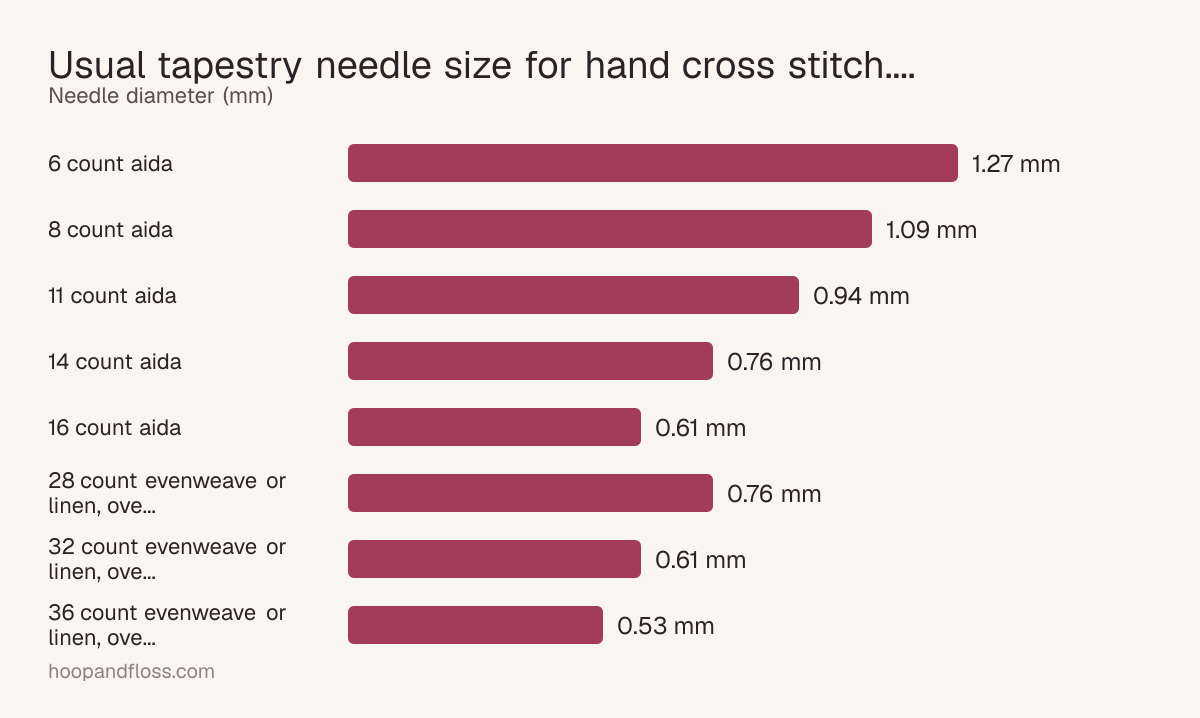
Note.A bigger number is a finer needle. Size 28 is the thinnest needle in this chart and size 18 is the thickest.
Which size needle for 14 count aida?
Size 24 is the standard cross stitch needle for 14 count aida. Each stitch on 14 count is 1.81 mm wide, and the 0.76 mm shaft of a size 24 passes through the holes without spreading them. Its eye takes the usual 2 strands of floss. The same needle suits 28 count evenweave or linen stitched over 2 threads, because that also works out to 14 stitches per inch.
Going one size finer is a matter of preference, not a mistake. A size 26 on 14 count slips more easily through holes that already hold thread, but its eye is tighter for 2 strands. On 18 count both size 28 and size 26 are in regular use, which is why the chart shows both.
How tapestry needle sizes run
Tapestry needles are numbered from 13 to 28, and cross stitch uses the fine end of that range, sizes 18 to 28, in even numbers. Each step up in number is a thinner and shorter needle. In John James's table a size 18 is 1.27 mm thick and 48.5 mm long, while a size 28 is 0.53 mm thick and 32.5 mm long.
People often search for embroidery needle sizes for cross stitch, but the two types are numbered on separate scales. Sharp embroidery (crewel) needles run from 1 to 12, so a pack marked 24 or 26 is never a crewel needle. It can be a chenille needle, though: chenille needles share the tapestry sizes and diameters but have a sharp point. Check that the pack says tapestry or cross stitch. The sharp types are covered in the hand embroidery needle size chart.
What happens when the needle is too big
A needle that is too thick for the count forces each hole wider as it passes. The fabric threads around the hole are pushed apart and do not fully close again, so the floss no longer fills the space. The result is visible holes at the corners of the crosses, stitches that look less neat, and a grid that can distort where many stitches meet.
A thick needle is also harder to pull through, most of all on the return row when the hole already holds thread. If your finished crosses show pinpricks of fabric at the corners, the needle size is one of the first things to check. The other causes are listed in why cross stitch has gaps.
Note.Rule of thumb: the needle should pass through the fabric smoothly without visibly stretching the hole. If you see the hole open, go one size finer.
What happens when the needle is too small
A needle that is too fine causes two problems. The first is at the eye: 3 strands for 11 count will not pass easily through the eye of a size 26 or 28, and floss that is squeezed through wears where it sits in the eye. The second is at the fabric. A thin needle does not open the hole enough for the doubled thread behind the eye, so the floss rubs against the fabric on every pull and starts to fray.
If the size is right for the count and threading is still slow, the fix is a threader, not a bigger needle. See the needle threaders for multi-strand floss.
Evenweave and linen: halve the count first
Evenweave and linen are usually stitched over 2 threads, so each cross covers two fabric threads in each direction. That halves the count: 28 count becomes 14 stitches per inch, 32 count becomes 16 and 36 count becomes 18. Pick the needle for the halved number: 24, 26 and 28.
Stitched over 1 thread, 28 count really is 28 stitches per inch. Use the finest needle, a size 28, with 1 strand. For 22 count Hardanger fabric, World of Cross Stitching magazine lists a size 26. For counts that fall between the published rows, the cross stitch calculator shows the nearest standard size. How count changes the stitch size is laid out in the aida count chart.
Does a cross stitch needle have to be blunt?
For full crosses, yes. Aida and evenweave already have a hole at every corner of the stitch. A blunt tip finds that hole and slides between the fabric threads instead of piercing them, and it does not split the floss of the stitch next to it.
The one common exception is fractional stitches. A quarter or three-quarter stitch on aida has to go through the solid center of a block, and some stitchers keep one sharp embroidery needle for that job. Strand counts for full crosses and backstitch are in the strands of floss chart.
Quick answers
Short answers to the needle questions cross stitchers ask most. Every size named here is a blunt tapestry needle for hand stitching.
- Which size needle for cross stitch? Match the fabric count: size 22 for 11 count, 24 for 14 count, 26 for 16 count and 28 or 26 for 18 count.
- What are cross stitch needles size 24 used for? 14 count aida and 28 count evenweave or linen stitched over 2 threads, usually with 2 strands of floss.
- What embroidery needle size is right for 14 count aida? A size 24 tapestry needle. Sharp embroidery needles are numbered 1 to 12 and are not the usual choice for counted work.
- Can one needle cover several fabric counts? Size 26 is the usual compromise. It is the standard needle for 16 count and is also widely used on 18 count.
Use this chart
Print it, save the image version, or put it on your own site or forum post with the code below. The code keeps a link back to this page as the source.
Embed code
<a href="https://hoopandfloss.com/blog/cross-stitch-needle-size-chart"><img src="https://hoopandfloss.com/charts/cross-stitch-needle-size-chart/image.png" alt="Cross stitch needle sizes: which tapestry needle for each fabric count" width="600" loading="lazy"></a>
<p>Source: <a href="https://hoopandfloss.com/blog/cross-stitch-needle-size-chart">Cross stitch needle sizes: which tapestry needle for each fabric count</a>, Hoop and Floss</p>
What you need for this
- See price on AmazonAmazon
DMC 1767-24 Tapestry Hand Needles, Size 24
From Best cross stitch needles: tapestry needles in sizes 24, 26 and 28
- See price on AmazonAmazon
DMC GD1436-0322 Gold Label Aida Fabric, 14 Count
From Best 14 count aida cross stitch fabric: brands, cuts and colors
- See price on AmazonAmazon
Charles Craft Silver Label Aida 18 Count
- See price on AmazonAmazon
BEADNOVA stainless steel needle threaders, 20 pcs
From Best embroidery needle threaders for multi-strand floss