Comparison
Embroidery floss vs thread: are they the same thing?
Published
Short answer
Embroidery floss and embroidery thread are two names for the same thing: a loosely twisted cotton thread made of six strands that you can pull apart, sold in 8 m skeins. Sewing thread is different. It is one fine, tightly twisted thread on a spool, made to hold seams, and it cannot be divided. Pearl cotton and craft thread are separate products too.
The confusion comes from labels. 'Thread' is the general word for anything that goes through a needle, and 'floss' is the name for one kind of it. A craft store shelf can hold six-strand floss, pearl cotton, craft or friendship thread and sewing thread side by side, and patterns use 'embroidery thread', 'cross stitch thread' and 'stranded cotton' for the same floss. Three things matter when you stitch: the fiber, whether the thread divides into strands, and what it was built to do. This page compares the four threads you are most likely to be holding.
Floss, pearl cotton, craft thread and sewing thread compared
Read the 'Divides?' column first. Only six-strand floss is made to be separated into strands, and that is the quickest way to tell it from everything else on the shelf.
| Thread | Fiber | Divides? | Made for |
|---|---|---|---|
| Six-strand embroidery floss (embroidery thread, stranded cotton) | Cotton. DMC: 100% cotton, double mercerized | Yes, into six strands | Cross stitch and hand embroidery |
| Pearl cotton, sizes 3, 5, 8 and 12 | Cotton, with a firm visible twist | No | Textured hand embroidery, used whole |
| Craft or friendship thread | Cotton or a cotton-polyester blend, by brand | Depends on the product: check the label | Friendship bracelets and general crafts |
| Sewing thread | Polyester, cotton or a blend | No | Seams, hems and buttons, by hand or machine |
Note.Machine embroidery thread is a different product again: a fine thread on a spool or cone for embroidery machines. It does not replace six-strand floss in hand work.
Is embroidery floss the same as thread?
Floss is a kind of thread, so every floss is thread but not every thread is floss. In hand embroidery and cross stitch the two words name the same product. 'Embroidery floss' is the main word, and 'embroidery thread', 'cross stitch thread' and 'stranded cotton' all mean the same six-strand cotton. A pattern that asks for thread in a numbered color and one that asks for floss in that color want the same skein.
The word only causes trouble when 'thread' means sewing thread. If it comes wound on a spool and the label says all-purpose or gives a weight, it is sewing thread. If it is a skein held by paper bands with a color number, it is floss.
What is embroidery floss made of?
Standard embroidery floss is cotton. DMC's six-strand floss is 100% cotton that is mercerized twice, a treatment that gives the thread its sheen, and it is sold as colorfast in 500 shades. Each skein is 8 m (8.7 yd) of six strands. Anchor stranded cotton has the same build: an 8 m skein of six strands, in 444 solid colors.
Floss also exists in other finishes, such as metallic and variegated lines, and these handle differently from plain cotton. Unbranded and hand-dyed floss may not be colorfast: test it before it goes into a piece you plan to wash. For how the thicknesses compare, including pearl cotton sizes 3 to 12, see the floss sizes chart.
Embroidery floss vs sewing thread: the real difference
They are built for opposite jobs. Sewing thread is meant to disappear into a seam and hold it: it is fine, tightly twisted and even, so it runs through fabric and through a machine without catching. Embroidery floss is meant to be seen: it is thick, soft and glossy, and its strands spread out to cover the fabric.
That is why they do not swap well. A single strand of floss is already a soft, loosely twisted thread, and all six together are many times thicker than sewing thread. Sewing thread in turn is too thin to fill a 1.81 mm square on 14 count aida, where the usual thread is 2 strands of floss. The strands chart gives the number for each fabric count.
Choose embroidery floss when
Floss is the right choice whenever the stitches are the point of the work and should cover or decorate the fabric. Pick it in these cases.
- The pattern is cross stitch or hand embroidery and lists colors by number. Those numbers are floss shades, usually DMC.
- You need to control thickness. One skein gives 1 to 6 strands, from a hairline to a bold line.
- The stitches should cover the fabric, as in cross stitch or satin stitch, where strands lie flat side by side.
- You want visible, decorative stitching on clothing, or mending that is meant to show.
Choose sewing thread when
Sewing thread is the right choice whenever the stitches have to hold something together or stay out of sight. Pick it in these cases.
- You are sewing a seam, a hem or a button that takes strain. A tight, even twist is built for pull and rubbing, loose strands are not.
- The thread goes through a sewing machine. Six-strand floss is a hand thread.
- You are closing the back of a finished hoop, where the stitches should hold and not show. See how to back an embroidery hoop.
- You want a line finer than one strand of floss, for the smallest details in a design.
Can you embroider with sewing thread, or sew with floss?
Embroidering with sewing thread works, with limits. The stitches form the same way, but the line is thin and covers little, because sewing thread is far finer than floss. It suits very fine detail and outlines. For anything that should look like normal embroidery, use it doubled or tripled, or switch to floss. On aida it will not fill the crosses. Keep the usual working length of at most 18 in (50 cm): any longer thread twists and knots, as covered in how long embroidery thread should be.
Sewing with embroidery floss is fine for decoration and light hand sewing: visible mending, a hand-stitched patch, a blanket stitch edge. Use 2 or 3 strands in a size 7 embroidery needle. For seams that carry load it is the wrong thread. The strands are loosely twisted and fluff with rubbing, so the seam is less dependable than one sewn with sewing thread. Do not put floss in a sewing machine. The needle side of the question is in embroidery needle vs sewing needle.
Embroidery floss vs craft thread
Craft thread, also sold as friendship thread or friendship bracelet thread, comes in multi-color bundles for bracelets and general crafts. It is not one standard product. Some is six-strand and divides like floss, some is a single twisted thread closer to pearl cotton, and the fiber can be cotton or a cotton-polyester blend. The label says which.
It can be used for embroidery, with three cautions. It may not divide, so you cannot set the number of strands. It often has no shade numbers that match a pattern key, so colors are picked by eye. And it may not be colorfast: wash a test length before using it on anything that will be washed. The washing guide describes the cold water method.
Quick answers
Direct answers to the label questions. In hand embroidery, floss and embroidery thread both mean the same six-strand cotton.
- Is embroidery floss the same as thread? It is the same as embroidery thread. It is not the same as sewing thread, which is finer, tightly twisted and does not divide.
- Can you embroider with sewing thread? Yes, for fine lines. It covers little, so double it or use floss for normal embroidery.
- Can you sew with embroidery floss? Yes, for decorative and light hand sewing with 2 or 3 strands. Not for seams that carry load, and not in a machine.
- What is embroidery floss made of? Cotton. DMC floss is 100% cotton, mercerized twice, in six strands.
- Embroidery floss vs craft thread: are they the same? Not reliably. Some craft thread divides into six strands, some does not, and it may not be colorfast.
What you need for this
 See price on AmazonAmazon
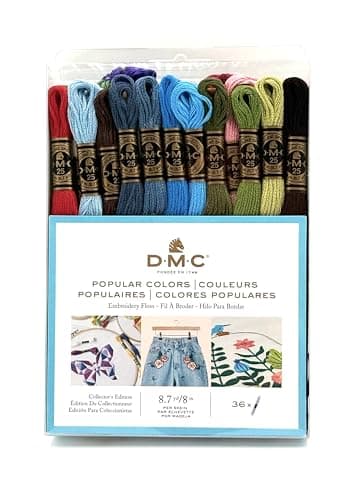
DMC six-strand floss, 36 popular colors, 8.7 yd
From Best embroidery floss for hand embroidery: brand sets compared
 See price on AmazonAmazon
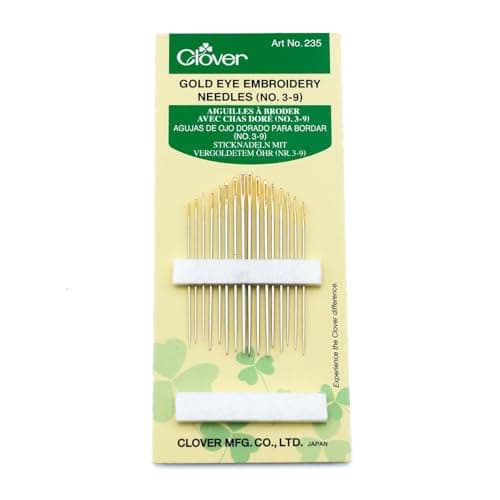
Clover gold eye embroidery needles, sizes 3-9, 16 pcs
 See price on AmazonAmazon
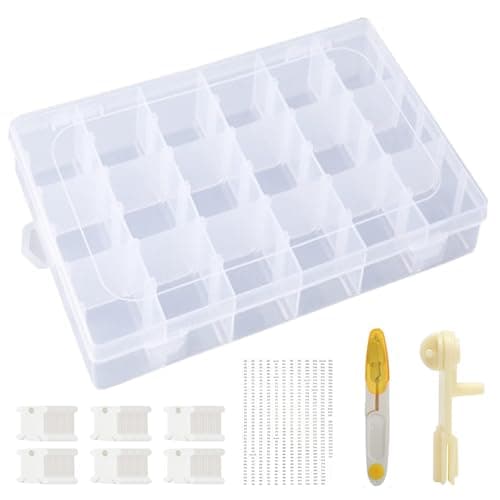
INFNZOLI 18-compartment big box, 120 bobbins, winder