Comparison
How to store embroidery floss: bobbins, drops, bags and binders compared
Published
Short answer
The five common ways to store embroidery floss are bobbins in a box, floss drops on rings, small zip bags, binder pages and whole skeins in drawers. Bobbins take the least space but every 8 m skein has to be wound. Bags and whole skeins need almost no setup. Whichever you pick, the color number must stay attached to the floss.
A handful of skeins fits in any tin. Once the pile grows it needs a system, because a pattern lists floss by number and a loose skein without its label is hard to identify. The right method depends on three things: how many colors you own, whether you buy whole skeins or stitch from kits with pre-cut lengths, and how much time you want to spend setting up before you stitch. This page compares the five methods on what to buy, setup time, space, how well the number stays with the floss and how likely the floss is to tangle.
Embroidery floss storage ideas: five methods side by side
Each row is one system. Setup time is per skein and is a rough guide only, since winding and cutting speed differs a lot from one person to the next.
| Method | What to buy | Setup per skein | Space taken |
|---|---|---|---|
| Bobbins in a box | Plastic or card bobbins, a compartment box, labels or a pen. A winder is optional | A few minutes to wind and label | Smallest. Bobbins stand in rows |
| Floss drops on rings | Drops (tags with a large hole and room for the number) and binder rings | A few minutes to cut, loop and label | Rings hang on a hook or lie in a box |
| Small zip bags | Floss bags or small zip bags, a marker, a ring or box to hold them | Under a minute. The skein goes in whole | Bulkier than bobbins. Bags stand in a box or hang on a ring |
| Binder pages | A ring binder and pocket pages sized for bobbins or bags | As for whatever goes in the pockets | A shelf, like a book |
| Whole skeins in drawers | Shallow drawers or boxes with dividers | None | A drawer unit, and more drawers as the collection grows |
Which method keeps the color number with the floss?
A storage system fails in two ways. The number gets separated from the floss, or the floss tangles when a length is taken out. The table rates each method on both.
On a DMC skein the color number is printed on the larger bottom label, next to the barcode. That paper band is the only place the number exists until you copy it somewhere else.
| Method | Does the number stay with the floss? | Risk of tangling |
|---|---|---|
| Bobbins in a box | Only if it is written or stuck on each bobbin as you wind | Low. Floss unwinds in order, with bends where it turned the card edge |
| Floss drops on rings | Yes, once it is written on the drop | Low. One cut length pulls free at a time |
| Small zip bags | Yes. The skein label stays in the bag, or the number goes on the bag | Low to medium. Leftover strands lie loose beside the skein |
| Binder pages | As for the bobbins or bags in the pockets | Low |
| Whole skeins in drawers | Only while both paper labels stay on the skein | Medium to high. A skein pulled from the wrong end knots, and labels slip off as it empties |
Note.Label first, then wind or cut. Write the number on the bobbin, drop or bag before the paper label comes off the skein, and handle one skein at a time.
Choose bobbins in a box when
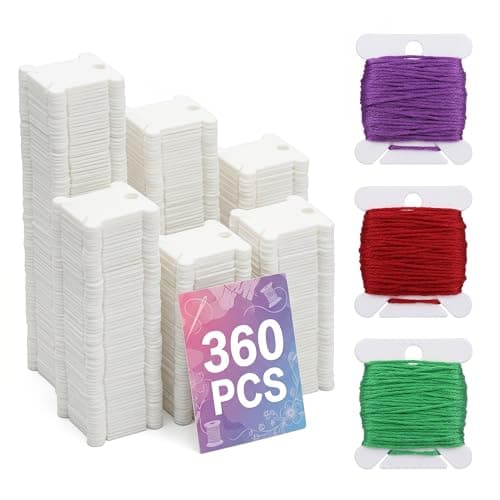
A bobbin is a flat card, plastic or cardboard, that takes one full 8 m skein. Bobbins suit a collection that is bought as whole skeins and keeps growing, since a box holds many colors in number order.
- You own many colors and want them filed by number in the smallest space.
- You buy whole skeins, not kits with pre-cut lengths.
- You do not mind winding. Each skein is wound once, by hand or with a winder.
- You want to see every color at a glance when the lid is open.
Note.Floss comes off a bobbin with bends where it turned the card edge. Wind without pulling tight to keep the bends soft.
Choose floss drops or zip bags when
A floss drop is a tag with a large hole. The skein is cut into lengths, folded in half and looped through the hole, so one length pulls out at a time. An 8 m skein cut at the standard working length of 50 cm (18 in) gives 16 lengths. Cut at 100 cm instead, it gives 8 lengths ready for a loop start. A zip bag is simpler still: the skein goes in whole, with its label.
- You stitch from kits. Pre-cut lengths do not wind neatly on a bobbin, but they loop onto a drop as they are.
- You want floss ready to pull, with no measuring or cutting in the middle of a session.
- You dislike the bends a bobbin leaves. Floss on a drop hangs straight.
- You want leftover strands kept with their color. A bag holds them next to the skein, and a drop takes them looped beside the full lengths. See how to separate embroidery floss.
- You pull colors for one project at a time. The drops or bags for that pattern go on one ring.
When binder pages or whole skeins in drawers make sense
Binder pages are a container, not a method of their own. Pocket pages hold wound bobbins or flat floss bags, and the binder stands on a shelf and flips open like a book. Choose a binder when shelf space is easier to find than drawer space, or when you carry floss to a class or group. The floss organizer guide covers boxes and binders.
Whole skeins in a drawer need nothing bought and no setup. That works for a small collection and for spare skeins kept as backup. Two rules keep it usable. Pull the floss from the end under the larger bottom label, slowly, and leave both labels on. A partly used skein loses its shape, so move part skeins to a bobbin or bag with the number written on.
Note.Whatever the system, a closed box, binder or drawer keeps dust and direct sunlight off the floss.
How to organize embroidery floss by number
File floss by number, not by color. Patterns list floss by number, and the numbers do not run in color order, so a box sorted by shade is slow to search. In a DMC collection the codes that are not plain numbers need a fixed place: ECRU, WHITE and B5200 at the front works, followed by 01 to 35 and then the rest in rising order.
A number means something only inside its brand. Keep each brand in its own box or on its own ring, and never file another brand's skein under a DMC number because it looks close. For DMC and Sullivans, the floss conversion chart gives the closest match as published by the maker. A full DMC range is 500 shades and Anchor lists 444 solid colors, which sets the upper limit for how many bobbins, drops or bags one brand can need.
A simple embroidery floss inventory sheet
An inventory sheet, or floss tracker, stops you from buying a color twice. Three columns are enough: floss number, brand and skeins on hand. Use one row per color you own, in the same order as the storage. Count a part skein as a half. The example shows the layout.
Paper works, and a spreadsheet sorts and searches faster. Before buying for a new pattern, check its key against the sheet and mark what is missing. To work out how many skeins a color needs, see cross stitches per skein. Update the count when a skein is finished, not at the end of the project.
| Floss number | Brand | Skeins on hand | Note |
|---|---|---|---|
| ECRU | DMC | 1 | Bobbin |
| 310 | DMC | 2 | Buy 1 more for the current pattern |
| 3865 | DMC | 0.5 | Part skein |
| 45053 | Sullivans | 1 | Closest match to DMC 310 |
Quick answers
Short answers to the storage questions asked most often. Every method works as long as the color number stays with the floss.
- What is the best way to store embroidery floss? For many whole skeins, bobbins in a box use the least space. For kits and pre-cut lengths, floss drops on a ring are easier.
- How do you organize embroidery floss? By number within each brand, because patterns list floss by number. Keep different brands apart.
- Is there a DIY embroidery floss organizer? Yes. Bobbins and drops can be cut from stiff card, with a punched hole for a ring. Small zip bags on a binder ring also work.
- What goes on an embroidery floss inventory sheet? Floss number, brand and skeins on hand, one row per color. A notes column for part skeins and colors to buy is optional.
- What is an embroidery floss tracker? The same thing as an inventory sheet: a list of the colors you own, kept on paper or in a spreadsheet.
What you need for this
 See price on AmazonAmazon
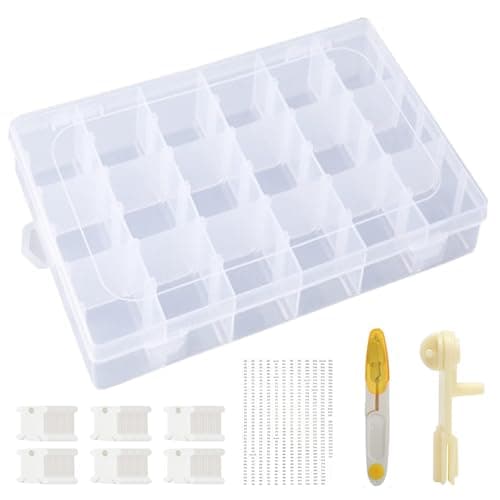
INFNZOLI 18-compartment big box, 120 bobbins, winder
 See price on AmazonAmazon
The Little Green Change plastic floss bobbins, 360 pcs
 See price on AmazonAmazon
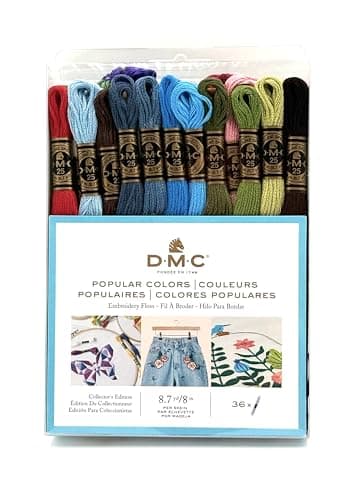
DMC six-strand floss, 36 popular colors, 8.7 yd
From Best embroidery floss for hand embroidery: brand sets compared