Explainer
How many cross stitches per skein: table by fabric count and strands
Published
As an Amazon Associate we earn from qualifying purchases. This does not change our picks. Affiliate disclosure
New to Prime? Try Prime free for fast, free shipping on eligible items.
Short answer
A standard 8 m (8.7 yd) skein of six-strand floss covers about 1,050 to 1,750 full crosses on 14 count aida with 2 strands. Published figures run from about 1,000 to 1,850. On 18 count with 2 strands the estimate is about 1,400 to 2,250, and on 11 count with 3 strands about 550 to 900. Treat every figure as a range.
Gear for this job
All 7 picks comparedDMC six-strand floss, 36 popular colors, 8.7 yd
See price on AmazonSee it on AmazonDMC embroidery floss assortment, 100 colors
See price on AmazonSee it on AmazonAnchor stranded cotton floss, 50 skeins, 8 m
See price on AmazonSee it on Amazon
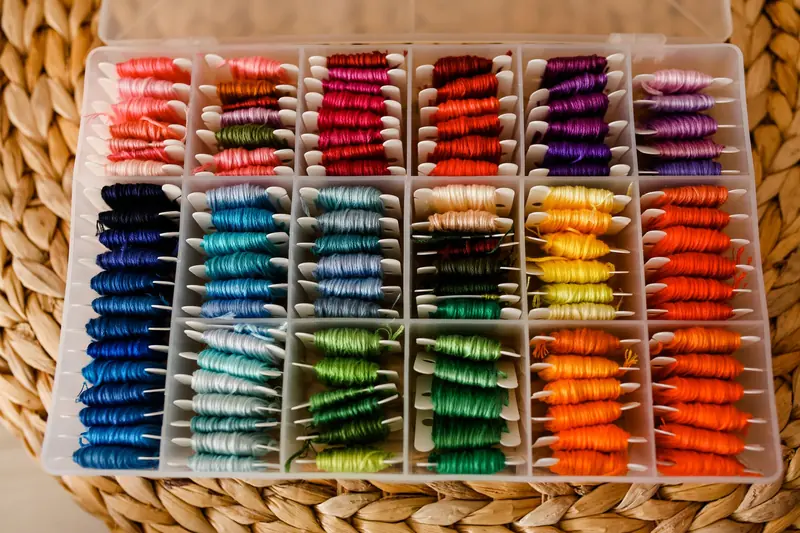
The question behind this one is how many skeins to buy. The answer depends on four things: the fabric count, the number of strands in the needle, how threads are started and finished, and how scattered the stitches of each color are. No single figure is right, and sources that print one disagree with each other. This page gives the skein length first, then a table of ranges by count and strands, the reason the ranges are wide, and a worked example. The cross stitch calculator does the same sums for any count.
How much embroidery floss is in a skein?
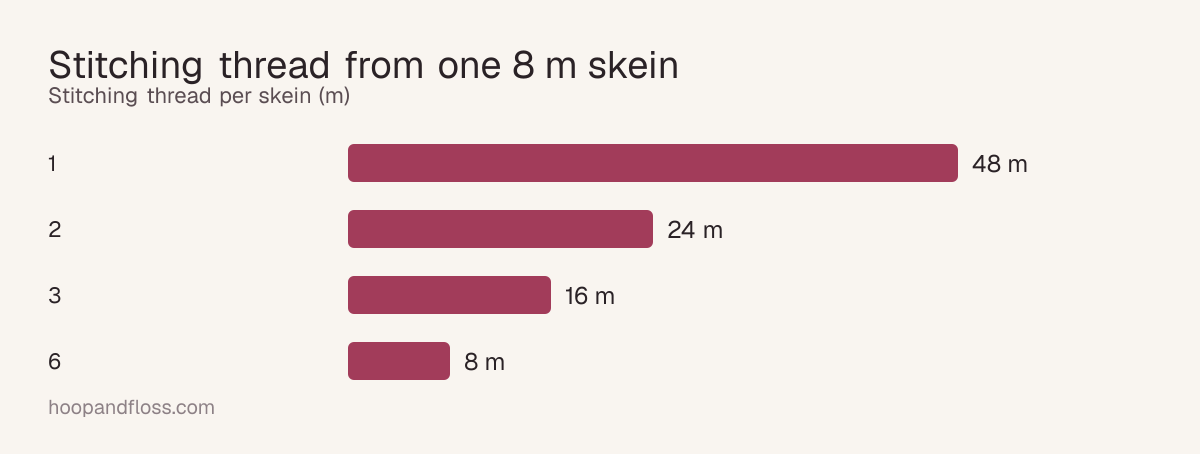
A standard skein of six-strand embroidery floss holds 8 m (8.7 yd). DMC and Anchor both sell stranded cotton in 8 m skeins. The six strands are separated and used a few at a time, so one skein gives more stitching thread than its length suggests: 8 m of six strands is 48 m of single strand.
| Strands in the needle | Stitching thread per skein | Lengths of 50 cm (18 in) |
|---|---|---|
| 1 | 48 m | 96 |
| 2 | 24 m | 48 |
| 3 | 16 m | 32 |
| 6 | 8 m | 16 |
How many cross stitches per skein, by count and strands
The table gives the estimated number of full crosses from one 8 m skein. Read across from the fabric count to the number of strands in the needle. The usual choice is 3 strands on 11 count, 2 strands on 14 and 16 count, and 1 or 2 on 18 count. The strands chart covers other fabrics and backstitch.
Evenweave and linen are usually stitched over 2 threads, which halves the count. A 28 count fabric over 2 reads the 14 count row, 32 count reads the 16 count row and 36 count reads the 18 count row. The count chart shows the stitch size for each.
| Fabric | 1 strand | 2 strands | 3 strands |
|---|---|---|---|
| 11 count aida | 1,700 to 2,750 | 850 to 1,350 | 550 to 900 |
| 14 count aida | 2,150 to 3,550 | 1,050 to 1,750 | 700 to 1,150 |
| 16 count aida | 2,500 to 4,050 | 1,250 to 2,000 | 800 to 1,350 |
| 18 count aida | 2,800 to 4,550 | 1,400 to 2,250 | 900 to 1,500 |
Why is the range for one skein so wide?
Start with the geometry. A cross worked in rows puts two diagonal legs on the front and two straight legs on the back. That path is about 4.83 times the width of one stitch. On 14 count a stitch is 1.81 mm wide, so each cross takes about 8.8 mm of thread. With 2 strands a skein gives 24 m, which would be about 2,740 crosses if every millimeter ended up in a stitch.
It never does. Thread is lost to the tail at every start and finish, to the thickness of the fabric at each pass, to ends too short to stitch with, and to travel across the back between areas. The table keeps 40% to 65% of the theoretical figure. That band is an allowance chosen to sit inside the spread of published figures. It is not a measured constant.
Published figures for 14 count with 2 strands run from about 1,000 to 1,850 full crosses per skein. Lord Libidan's table, for example, lists 1,650 to 1,850 for 14 count and 2,200 to 2,300 for 18 count depending on how efficiently the thread is used, and does not state the number of strands.
What pushes a project to the low or high end
Count and strands set the range. Stitching habits decide where in the range a project lands. A finer fabric has smaller stitches, so the same thread covers more of them, as the figure shows: a stitch is 2.31 mm wide on 11 count and 1.41 mm on 18 count.
- Scattered single stitches of one color need a start and a finish for very few crosses. Expect the low end.
- Solid blocks stitched in long rows waste the least thread. Expect the high end.
- A loop start leaves no starting tail, which saves a little thread on every length.
- Long tails, knots and thread carried across the back all use floss that never becomes a stitch.
- Finishing each cross before moving to the next, instead of working in rows, changes the path on the back, so the thread per cross differs from what the table assumes.
Worked example: how much embroidery floss do I need?
Take a 140 x 100 stitch design on 14 count aida, stitched with 2 strands, with 14,000 full crosses in total. The table gives 1,050 to 1,750 crosses per skein for that combination.
- 1
Find the number of full crosses for each color in the pattern key. If the key gives no stitch counts, estimate them from the chart.
- 2
Divide the stitches by the high figure to get the fewest skeins: 14,000 / 1,750 = 8 skeins.
- 3
Divide by the low figure to get the most: 14,000 / 1,050 = 13.3, rounded up to 14. The whole design takes about 8 to 14 skeins.
- 4
Repeat for each color, because floss is bought by color. A color with 2,400 crosses gives 2,400 / 1,750 = 1.4 and 2,400 / 1,050 = 2.3, so buy 2 to 3 skeins of it.
- 5
Any color with fewer than 1,050 full crosses needs 1 skein on 14 count with 2 strands.
Note.Every color rounds up to a whole skein. A design with 30 colors needs at least 30 skeins, even when the total stitch count alone suggests 8 to 14.
How many skeins to buy when the answer is a range
For a large area in a single color, such as a full background, buy the higher number of skeins at the start. A skein bought later can come from a different dye lot, and a small shift in shade shows in a solid block. For colors used in small amounts the lower number is usually safe, because one skein already covers at least 1,050 crosses on 14 count.
The ranges count full crosses only. Backstitch, half stitches, French knots and blended colors, where two shades share one needle, are not included, so add to the total for a pattern that uses a lot of them. Surface embroidery has no fabric count to divide by. For that, follow the thread list printed with the pattern. The calculator takes the stitch count and returns the skein range for 11 to 18 count and beyond.
Quick answers
Short answers on skein length and coverage. All stitch figures are estimates for one 8 m skein and count full crosses only.
- How many cross stitches per skein on 14 count? About 1,050 to 1,750 full crosses from a DMC or other 8 m skein with 2 strands. Published figures run from about 1,000 to 1,850.
- How long is a skein of embroidery floss? A standard skein of six-strand floss is 8 m, which is 8.7 yd. Used 2 strands at a time, that is 24 m of stitching thread.
- DMC floss, how many yards? Six-strand floss is 8.7 yd per skein. Pearl cotton comes in other lengths, listed in the floss sizes chart.
- Is there an embroidery floss calculator? Yes. The cross stitch calculator on this site turns a stitch count into a skein range for the chosen count and strands.
- How much embroidery thread do I need? Divide the full crosses of each color by the range for your count and strands, and round up to whole skeins.
What you need for this
- See price on AmazonAmazon
DMC six-strand floss, 36 popular colors, 8.7 yd
From Best embroidery floss for hand embroidery: brand sets compared
- See price on AmazonAmazon
DMC GD1436-0322 Gold Label Aida Fabric, 14 Count
From Best 14 count aida cross stitch fabric: brands, cuts and colors
- See price on AmazonAmazon
Charles Craft Silver Label Aida 18 Count