Embroidery stitches for flowers: petals, roses, leaves and stems
Published
As an Amazon Associate we earn from qualifying purchases. This does not change our picks. Affiliate disclosure
New to Prime? Try Prime free for fast, free shipping on eligible items.
Gear for this job
All 6 picks comparedClover Gold Eye Embroidery Needles, 16 Pack
See price on AmazonSee it on AmazonJohn James embroidery needles, sizes 5/10, 16 pcs
See price on AmazonSee it on AmazonSINGER Crewel Needles in Dial Compact, Set of 24
See price on AmazonSee it on Amazon
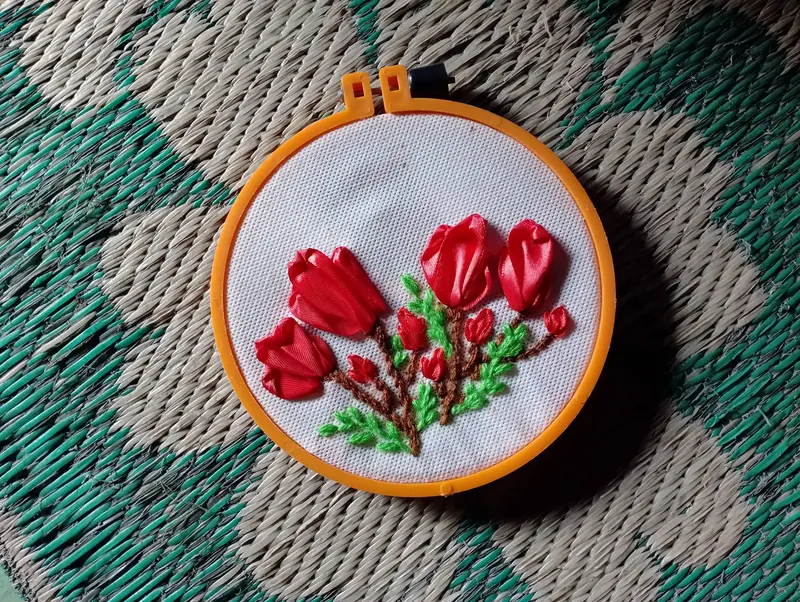
The most useful embroidery stitches for flowers are lazy daisy for small petals, satin and long and short stitch for solid petals, woven wheel and bullion knots for roses, French knots for centers and tiny blooms, fishbone and fly stitch for leaves, and stem stitch for stems. With those ten you can stitch almost any floral pattern. The choice depends on the flower's size and shape, and on how many strands you use: fewer strands for fine, flat petals, more for raised texture.
Small petals: lazy daisy and French knots
Lazy daisy, also called detached chain, is the fastest petal stitch. Bring the needle up at the flower center, go back down in the same hole, come up at the petal tip with the loop under the needle, and anchor the loop with a tiny stitch over it. Five or six arranged in a circle make a daisy; a single one makes a leaf or bud. Use two to three strands for small flowers and four to six for bold ones.
French knots make centers, baby's breath, lavender and lilac clusters. Bring the needle up, wrap the floss once or twice around it, and go back down just beside where you came up, holding the wraps snug as you pull through. Changing the number of strands, not the number of wraps, gives the most consistent size: two strands for tiny dots, four to six for larger ones. A dense cluster of knots in two or three close shades reads as a hydrangea or lilac head.
Solid petals: satin stitch and long and short
Satin stitch fills a small shape with straight stitches laid side by side. Outline the petal first with split stitch or backstitch, then work satin stitches across the shape, covering the outline so the edge looks crisp and slightly raised. Keep stitches parallel and angled toward the flower center for a natural look. Satin works best on shapes under about half an inch across; longer stitches snag and sag.
For larger petals, use long and short stitch, the classic thread painting technique. The first row alternates long and short stitches along the outer edge; following rows split into the previous row, blending shades from light at the tip to darker at the base. One or two strands give the smoothest blend. Work stitches in the direction the petal grows, fanning toward the center.
Roses: woven wheel, bullion and cast-on stitches
The woven wheel rose, or spider web rose, is the easiest rose. Stitch five straight spokes from a center point in an odd number, then bring the needle up near the center and weave over and under the spokes, round and round, without piercing the fabric, until the spokes are hidden. Use six strands or pearl cotton for a full rose. Pull gently for a tight bud and loosely for an open bloom.
Bullion knots give tightly wrapped, coil-shaped petals for roses and rosebuds. Take a stitch the length of the petal, wrap the floss around the needle until the wraps match that length, then pull through while holding the wraps and lay the coil down. A few curved bullions around a central one make a rose. They take practice; a milliner's (straw) needle, with an eye no wider than the shaft, makes pulling through the wraps much easier.
Leaves: fishbone, fly stitch and satin
Fishbone stitch makes a leaf with a center vein in one pass. Start with a short straight stitch at the tip, then alternate slanted stitches from each side edge to just across the center line, working down toward the stem. The overlapping stitches create the vein. It suits leaves from about a quarter inch to an inch and a half long.
Fly stitch is a V-shaped stitch anchored with a small tack. Stacked down a center line it makes a feathery leaf or fern; a single one makes a sepal under a rosebud. For tiny leaves, a lazy daisy or two satin stitches side by side is quicker. Use two or three strands for most leaves, and pick two greens, one darker for leaves in shadow.
Stems and outlines: stem, split, chain and backstitch
Stem stitch is the standard stem. Work small stitches along the line, each coming up halfway along and beside the previous one, always keeping the floss on the same side of the needle. It gives a rope-like line that curves smoothly. Shorter stitches, around 2 to 3 mm, follow tight curves better.
Split stitch makes a fine, solid line and is the best outline under satin stitch. Chain stitch gives a bolder, textured stem or vine. Backstitch is the simplest line, good for thin stems and outlining petals in a cartoon style. A whipped backstitch, where you wrap a second thread around a finished backstitch line, makes a smooth, slightly raised stem.
Putting a floral design together
Stitch in layers: stems first, then leaves, then flowers, then knots and details on top, so the later stitches cover the ends of the earlier ones. Keep fabric drum-tight in a hoop, especially for satin and knots, and use a sharp crewel needle sized to the strand count: size 7 or 8 for two strands, size 5 for four to six.
Vary texture to create depth. A flat satin petal beside a raised woven rose and a cluster of French knots looks richer than the same stitch everywhere. Transfer the design with a water-soluble pen or stick-and-stitch paper, and keep the lines thin so the stitches cover them fully.
Frequently asked questions
What is the easiest embroidery stitch for flowers? Lazy daisy. Five loops around a center make a flower, and a French knot finishes the middle.
How do you embroider a rose? The easiest way is the woven wheel rose: five spokes, then weave floss over and under them in a spiral until they are covered.
How many strands should I use for embroidered flowers? Two or three for most petals and leaves, one or two for long and short shading, and four to six for woven roses and bold French knots.
Which stitch is best for leaves? Fishbone stitch gives a leaf with a center vein in one pass. Lazy daisy works for tiny leaves.
What you need for this
- See price on AmazonAmazon
Clover Gold Eye Embroidery Needles, 16 Pack
- See price on AmazonAmazon
DMC six-strand floss, 36 popular colors, 8.7 yd
From Best embroidery floss for hand embroidery: brand sets compared
- See price on AmazonAmazon
Nurge square plastic embroidery hoops, set of 3
From Best embroidery hoops for hand embroidery: wood vs plastic
- See price on AmazonAmazon
Cyanfour Embroidery Kit for Beginners
From Best embroidery kits for beginners and adults learning hand embroidery